Thursday, May 6, 2010

The Diana Mini Camera, Expensive!

Diana Mini CameraThe Online Photographer is commenting on the most overpriced camera in the world. In his opinion it's not Nikon D3x or Leica S2, it's the Diana Mini! The little plastic camera that's worn like jewellery by trendy people in trendy places.

The overpriced camera tag is probably correct, assuming that a camera that costs $1 (a guess), to make - and sells for up to $100, that's a healthy mark-up. But that's the price people are willing to pay for distinctive analogue snapshots, plus it looks very cute.

Wednesday, May 5, 2010

A letter to photo magazine editors

Urinals, England. Photograph by Tim IrvingUrinals - England

Dear Editor of (add name here) photography magazine,

I'm just letting you know that I've stopped buying your magazine today. I wouldn't normally bother writing to a magazine I no longer read, but as I've been a reader for 30 years I thought I'd let you know my reasons (as they may apply to other ex-readers too!).

I find that the magazine no longer speaks to me and the images do not engage me. In the past I've bought your magazine for a single article, test report or even to read the adverts, but recently I've found very little to catch my eye.

My principle reason for not buying your magazine is that there are too many photographs and articles on landscape photography, the same goes for nature photography. I've been overloaded by photographs of the Isle of Skye and Arizona (plus several other old chestnuts), that all look the same. I'm tired of seeing step by step articles on how to photograph a bunch of flowers, or take a portrait of a child. This style of photography is called pictorialism and it's of a very poor quality.

Your test reports used to be useful and well written, but now I find them long winded, and just like tests on the internet, packed with more information than I or most people need. I've noticed that magazines are no longer satisfied with testing cameras and lenses but are now giving their opinions on everything from winter gloves to lens wipes.

Apart from the test reports, I've noticed that there seems to be less writing in the magazine. An average week will see the appraisals of reader's photographs, reader's letters, famous photographs or photographers, an article on landscape photography, a bit of news about new products, and a short editorial. Added together it's probably less than 30 minutes reading. There is nothing new there for me.

I'm guessing that the target audience for most photography magazines are people of 55 and older. The reason I'm drawn to this conclusion is because I see plenty of photographs of historic houses, public gardens, vintage cars, airshows, not forgetting the landscapes, flowers and animals. I'm no teenager but I find these subjects very, very dull.

So goodbye photography magazines - you've failed to surprise or shock, or even amuse me for the past few years and now I've cancelled my subscription. From now on I'll buy a newspaper or a book when I travel by air or train.

Kind regards

Tim

Monday, May 3, 2010

Putting a price on your art

Art 4 Pocket Money exhibition. Photograph by Tim IrvingArt 4 Pocket Money exhibition

I attended an interesting show on Saturday by the artist John Williams at the Edmund Gallery in Bury St Edmunds. The show is called "Art 4 Pocket Money", it lives up to its billing with prints from £1, yes one pound for an A4 print, that's less than the cost of a sheet of good quality photographic paper. The most expensive art I saw was £35 for a 3D piece that had a lot of time and effort put into it.

The exhibition made me think of how we value our art, something most artists have problems with. Price it high and it becomes desirable, if not affordable. Price it low and the perceived value of buyers is that it's cheap. It's a very difficult balancing act. Obviously John Williams is not doing this for the money and I applaud him for putting his name to this, I wish him luck.

Thursday, April 29, 2010

Film developing and scanning service

Scooter , Paris. Photograph by Tim IrvingDeveloped and scanned by Genie

Having lived in Spain for 8 years, I've had to develop the art of patience. Where I lived in Spain I had the option of driving to the nearest city and dropping my films off at a camera shop, then waiting up to 2 weeks to get them back or, do it myself. Now I'm back living in England and I'm spoiled by the fast service I get!

The postman just delivered a package of negatives and CD's that were developed and scanned by Genie Imaging in South London. This is the first time I've used Genie and I couldn't be more happy with the quality of the service which costs £7.90 to develop a C41 or E6 film and scan each negative. The scans are 18MB and using Kodak Ektar 100 in my 35mm cameras, I can have the scans printed to 20"x16" (£7.90 from my lab, using archival photo paper, not inkjet), and the quality is superb. I could probably go larger than 20"x16" but it hasn't been asked for yet.

I currently use 3 labs for different services (dev and scan, printing and mounting), I'd be interested to know if anyone out there uses a similar service - and are you equally pleased with it? I'm always on the look out!

Wednesday, April 28, 2010

The Alternative Digital Camera

Greetings. Photograph by Tim IrvingGreetings

Over the many years I've been a photographer I've gone through my fair share of alternative processing techniques - Bromoil, Cyanotypes, Gum bichromates plus Polaroid transfers which I still practice. Using one of these processes is all about craft, and making each image unique and personal. Most of the processes are labour intensive, some are smelly and a few are dangerous. Oh, and with all of them you waste a lot of expensive paper!

For the past couple of years I've been playing with a digital camera that's frustratingly difficult to get an image out of but just like any alt processes, it can be very satisfying when it works.

I came to own and love the JamCam by accident. I was looking for a cheap digital camera to photograph a few things to put on Ebay. I searched Ebay for a digital camera and sorted the results by "Price Lowest First" as my main criteria. The JamCam wasn't top of the list, but it was on the first page with a price of £8.99 plus 2.50 shipping - Buy It Now - and I should mention that the camera was new in a box with a manual and software. The description said it was a full size digital camera, not one of those that hang off a key chain. The summary had the magic words "Perfect for listing on Ebay". What was there to lose? I bought and paid.

The camera arrived sealed in its original packaging, but before I could use it I had to buy a 16MB MMC memory card, and a PP9 battery. The battery I bought locally, but I could only find
a 16MB MMC card on Ebay which meant a further wait of a few days before I could start using the camera.
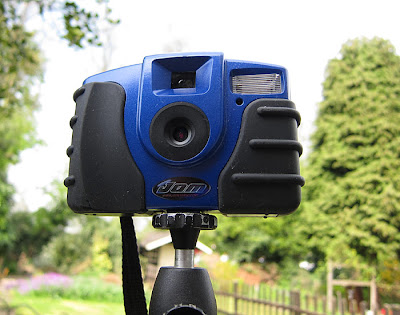
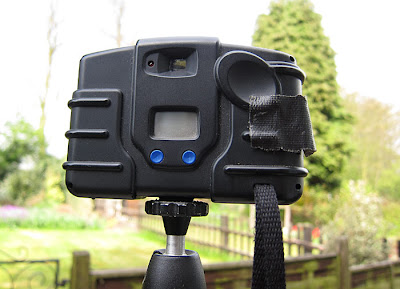
The JamCam. Photograph by Tim Irving
JamCam. Photograph by Tim Irving
The JamCam was made around the end of the last century and originally cost around $90 new. It features an excellent optical viewfinder, a 640x480 sensor, a built in flash and you can choose
between low resolution 320x240 or high resolution 640x480. If you shoot 640x480 you get 8 images on the card.

I assumed that I'd be able to download the images directly from the MMC card, but this isn't
possible (I tried, believe me). This is a big problem because the software (drivers), that come
with the camera don't work, and from what I've read, never did work. However, there is a very
useful web site where the latest drivers (circa 2003), can be downloaded, and there's also
instructions on how to install them, but it's all hard. I could spend a lot of time telling you of the frustrations I experienced over several hours installing the software but I don't want to re-live the experience! If anyone wants to try installing the drivers, I suggest you print off the instructions from the web site and follow them to the letter, good luck. With the software installed you can start taking photos and downloading them via a USB cable.

Photograph by Tim IrvingJamCam Roses

Using the camera.........

If all early digital cameras were designed like the JamCam, the manufacture of film cameras would never have declined, it can best be described as difficult.

Fit a new good quality PP9 battery. Install and format the MMC card. Set the resolution to High,
that's 8 photographs on the card. Go shooting. If only.

First - battery life. I couldn't believe the amount of power this camera uses. I've never got more than 15 photographs out of a fresh battery and I never use the flash. To begin with I thought
the batteries were at fault and I changed brands, but nothing improved the situation. You can
actually see the power drain away as the LCD goes dim for several seconds as the camera writes
to the card.

If the battery use is excessive the management of memory is bizarre. Whether it's the camera, the card (I tried 3 cards and nothing improved the situation), or the software, retrieving all the photographs is hit and miss. Sometimes the photos are there and sometimes they're not, and sometimes they appear after several weeks. The strange thing is I don't think I've ever lost a photograph, they all turn up in the end.

Photograph by Tim IrvingJamCam Lilies

The images.....

I love the images produced by this camera, the colours, the contrast - they're just up my street. I love how it paints the colours thick but still handles the details. The lack of resolution isn't a problem, the images up-res easily and I've printed and sold 12x16 prints that look wonderful. Also, just like the alt process, you have to do some work to get images from the JamCam, they're unique and personal.

Recommended for anyone with plenty of time to spare.
Not recommended for Ebay sellers.

Friday, April 23, 2010

CODEG a Diana Camera Clone

Hello to everyone - wherever you are!
It's St. George's Day here in England, a great day to kick off this new blog.

Beach huts. Photograph by Tim IrvingSuffolk coast - From a Diana clone, CODEG camera

Let me introduce you to the Diana clone.

This particular one is a CODEG, number 151, made in Hong Kong. However, there are dozens of other brands from ACME to Zodiac. These Diana cameras were re-badged and given given away as promotional gifts by companies like Readers Digest and Avis cars, some were branded by shops and sold under thier own name. All Diana's and her clones are very similar and they're usually very good cameras.

These cameras take 120 film and you get 16 photographs from a roll. A nice touch is that the negative is square and measures 425mm x 425mm. I don't know if this was an intentional design feature but by not exposing the edge of the negative there's no vignetting (dark corners), that you get on some toy cameras. Also the image isn't central on the negative, quirky eh!
Negative from a Diana Clone. Photograph by Tim IrvingNegative showing edge fog

Except for the shutter and the control levers, everything on this camera including the lens and viewfinder is honest plastic. The controls are:
Aperture - sunny, sun with cloud and cloudy.
Focusing - 4-6 ft, 6-12 ft, 12ft to infinity.
Shutter - B and I.
Other features, err no!

Codeg, Diana clone. Photograph by Tim IrvingI've used my CODEG on three outings, sticking with Kodak Ektar film each time, the results have been consistantly to my liking. I set the exposure to suit the weather, the distance is left on 6-12ft and the shutter on I and that's it.

I discovered after my first roll of film that you have to take care loading the film, make sure it's nice and snug on the spool otherwise it becomes slack and you get edge fogging. Having said that, because the image is away from the edge of the film the fogging is minimal.

The lens on my camera is very nice. Unique, low image contrast and full of charm.

Codeg camera box. Photograph by Tim IrvingTo sum up, I'd say the Diana and her clones are very elegant cameras allowing you to concentrate on the picture. After you've seen the results from a couple of rolls of film you'll get a feeling for what works and what doesn't, when to use it and when to go home.

Don't forget to wind on after each shot!

LinkWithin

Related Posts with Thumbnails

Google Plusone